
The Prophecy (The Trojan Horse Strategy)
He named the exact sin — and it wasn't the one everyone assumes. Then He did what no strategist would dare: He let His own presence be captured.
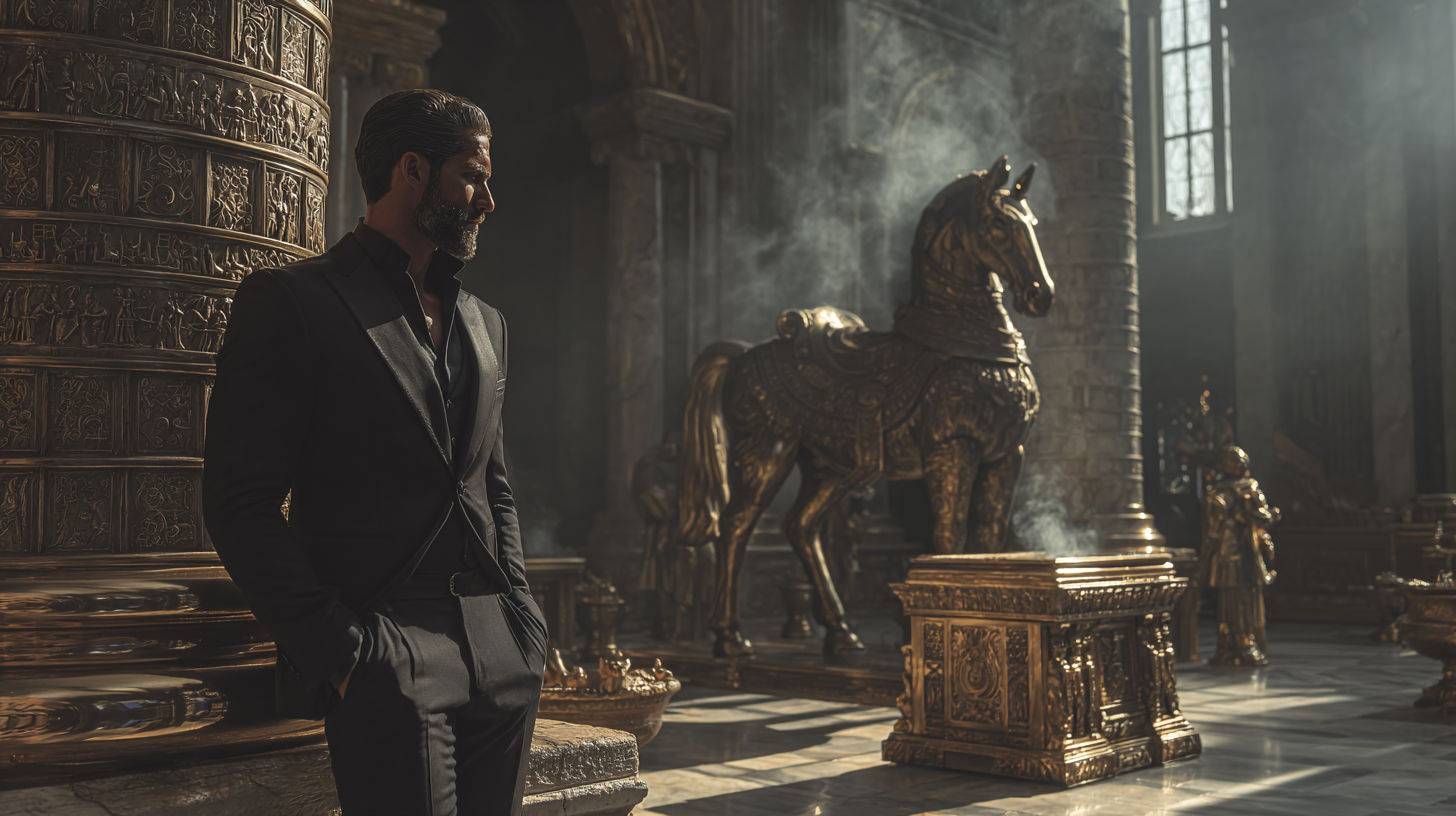
The written decode below deepens the teaching.
Hey Emperor. Sit with me a minute. I want to walk you through what I saw in this prophecy — and I need you to read it the way a strategist reads a map, not the way it gets read on a Sunday. Because buried in this story is a move so bold no general alive would sign off on it. But the move won't land unless you see what comes right before it. So start with me at the judgment.
You know the story on the surface: two corrupt sons, an old priest who couldn't rein them in, a house that falls. That reading isn't wrong. It's just shallow. What stopped me wasn't that judgment came. It's how specific it was — and who it landed on.
Allah didn't indict the leadership in general. He didn't say the priesthood had drifted. He named the exact sin. The sons were seizing the offering by force — taking what was set apart before it was ever given, treating the holy like appetite. And they were lying with the women who served at the door of the tent. Nothing vague about it. They used the office to feed the flesh, and they used their nearness to the holy as access to it.
But that isn't the sin that couldn't be forgiven.
Here's where the story turns, Emperor, and almost nobody catches it. When the final judgment is spoken, the offense named isn't the sons' corruption. It's Eli's. And not for what he did — for what he saw. He knew. He rebuked them once, mildly, and then let them keep serving. He remained the head of the priestly house while the house was being corrupted underneath him. The word used is a word that means to weaken, to dim, to restrict — and he never did it. He never weakened his sons' ability to continue. He let the corruption have full run of the sanctuary.
His knowing and not acting was itself the offense. Read that again. The one who watched drew the sentence. Not because watching equals doing — it doesn't — but because the watcher held the position and the authority to intervene, and chose not to. God holds those accountable who watch, in a way the actors alone are never accountable, precisely because the watcher could have stopped it and didn't.
“Vagueness is how men judge. Precision is how God judges. And the precision landed on the man who saw it and stayed quiet.”
Now the part that should reorganize how you think about systems.
The sentence was that this iniquity would never be atoned for by sacrifice or offering. Sit with how strange that is. Ordinary sin gets atoned for through the sacrificial system — that's the entire function of the priesthood. But this one couldn't be, and the reason is structural, not emotional. The corruption was at the head of the very system that performs atonement. The mechanism of atonement is not available for the corruption of the mechanism. A system cannot repair what it participated in.
And Emperor, this is not ancient history. This is the most useful thing in the whole chapter, because the pattern is universal. When the people who administer justice are the ones committing or protecting injustice, the justice system cannot atone for what happens inside it. Filing complaints through the system to address failures of the system is the sacrificial system trying to atone for corruption in its own priesthood. It does not work. It cannot work.
Watch how it operates. The corruption at the head controls the mechanism, so every attempt at internal repair passes through the corruption itself. Complaints are filtered by peers of the corrupt. Appeals are decided by people of the same class as those being overseen. Even individuals of real integrity inside the system operate within norms the corruption established. The system protects itself. That is its nature, not its failure. It cannot atone for what it houses.
“The mechanism cannot repair what it participated in. Something outside the corrupted system has to arise.”
Look at where that applies and you'll recognize your own life somewhere in the list: courts where those enforcing the law commit or shield injustice. Religious institutions where clergy harm and the institution covers them. Medical systems where boards protect the practitioner. Corporate governance where leadership is the source of the wrongdoing. Wherever a system is captured at its head, its internal mechanism cannot deliver accountability. Ever.
And notice how the transition actually gets made. The word had gone rare — the whole era was divine withdrawal, because when a system is corrupted at its head, the source stops feeding it directly. That silence creates the vacuum. Then the new voice is called from inside the old house: a boy serving in Eli's own sanctuary, young enough to have been protected from participating. He served, but he did not compromise. And the judgment against the old order was delivered through him — which means the man being judged had to hear his sentence from the mouth of the one who would replace him.
Now the move.
Israel goes to war at Ebenezer. And here's the first thing to catch: they were never commanded to fight it. There's no instruction to engage. They lose four thousand men, and then watch what they do not do. They don't ask whether the engagement was aligned. They don't seek a prophet. They don't consult Samuel — who is by now the established prophet in Israel. They do not examine themselves at all. They simply assume they should have won and something must be missing.
So they go get the Ark. They treat the presence as a weapon they can deploy — a talisman, a mechanism that produces victory automatically because it contains the holy. They never ask whether the presence wills the victory. They attempt to use it for their purpose. And it's the corrupted priests themselves who carry it out to the battlefield, carrying the very thing into the very situation that will kill them, exactly as it was spoken.
Israel isn't just defeated — it's slaughtered. The sons die on the same day. And the Ark is captured, hauled off as a war trophy. Eli takes the news in order: the army fled, great slaughter, both sons dead — and he does not react to his sons. It's the word that the Ark is taken that kills him. His daughter-in-law goes into labor on the news, names the child Ichabod, and dies. The glory has departed. Not because God abandoned Israel. Because Israel treated the presence as something to deploy, and the presence will not remain where it's misused.
What the enemy actually took.
The Philistines do what victors did: they set the captured god in the temple of their own, subordinate to Dagon. Ritual of victory. Morning one, Dagon is face-down before the Ark. They stand him back up. Morning two, he's down again — this time with his head and both hands broken off, lying on the threshold. Only the trunk remains. The head, which is thought and authority. The hands, which are action and power. The body stays; the operating parts are severed.
And Emperor, mark this: the Ark did nothing. No Israelite did this. The presence, simply by being in that space, produced the result. Dagon could not remain standing before it. Then the affliction spreads — city to city, seven months of it, every city that receives it struck. They cannot use it. They cannot benefit from it. They cannot even keep it in one place without generating catastrophe. In the end they send it home with gold — tribute for having taken it at all, because possession of the presence generated a cost that had to be settled.
“Whatever essence is wrongfully taken, the taking looks like victory to those who take it. But the essence operates by its own logic. The takers cannot use it.”
So look again at what actually happened. He didn't send fire to defend the Ark. He allowed the capture — not because He was defeated, but because His essence inside enemy territory would produce what no army could produce. The taking was the mechanism. He didn't need an army. The essence is the operation.
Now here's what I'm not going to do.
I'm not going to hand you the whole reading in a blog post, Emperor. I'm not going to open up what the head and the hands mean for the enemy operating in your own life right now, what the threshold is and why it kept Him at the door, why the wrong reception on the correct side still carried consequences, or where the presence finally came to rest twenty years later. That's the full reading. And the full reading is in the video.
The Operator Move.
Three things to carry out of this. First — get specific about the sin. In your house, in your leadership, in yourself. Don't say "I lost my way." Name the exact hinge. You can't heal what you keep vague. Second — audit what you're watching. If you hold the position and the authority to intervene and you're choosing not to, understand that you are not a bystander in this economy; the watcher carries a weight the actors don't. Eli's whole house fell on that. Third — stop appealing to a captured system to correct itself. If the corruption sits at the head, the internal mechanism will protect what it houses, and every appeal you file feeds it your time. Build the thing outside it instead. That's what Samuel was.
And last: stop reading apparent defeat as actual defeat. Some of what looks like your capture is your positioning. Learn to tell a loss from a delivery — because the enemy can't, and that's exactly how he loses.
Now go watch the video. That's where I open the reading all the way.